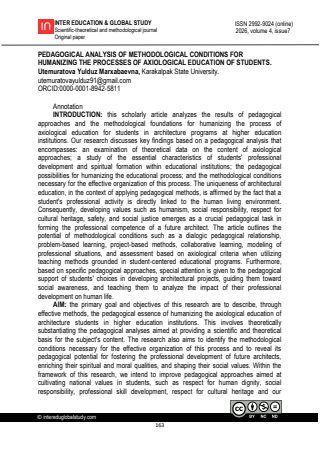
this scholarly article analyzes the results of pedagogical approaches and the methodological foundations for humanizing the process of axiological education for students in architecture programs at higher education institutions. Our research discusses key findings based on a pedagogical analysis that encompasses: an examination of theoretical data on the content of axiological approaches; a study of the essential characteristics of students' professional development and spiritual formation within educational institutions; the pedagogical possibilities for humanizing the educational process; and the methodological conditions necessary for the effective organization of this process. The uniqueness of architectural education, in the context of applying pedagogical methods, is affirmed by the fact that a student's professional activity is directly linked to the human living environment. Consequently, developing values such as humanism, social responsibility, respect for cultural heritage, safety, and social justice emerges as a crucial pedagogical task in forming the professional competence of a future architect. The article outlines the potential of methodological conditions such as a dialogic pedagogical relationship, problem-based learning, project-based methods, collaborative learning, modeling of professional situations, and assessment based on axiological criteria when utilizing teaching methods grounded in student-centered educational programs. Furthermore, based on specific pedagogical approaches, special attention is given to the pedagogical support of students' choices in developing architectural projects, guiding them toward social awareness, and teaching them to analyze the impact of their professional development on human life.
подходов и методические основы гуманизации процесса аксиологического воспитания студентов архитектурного направления в высших учебных заведениях. В ходе нашего исследования обсуждаются основные данные, полученные на основе педагогического анализа, который включает в себя: анализ теоретических сведений о содержании аксиологических подходов, изучение особенностей профессионального развития и сущности духовного становления личности студента в образовательных учреждениях, рассмотрение педагогических возможностей гуманизации образовательного процесса, а также определение методических условий, необходимых для его эффективной организации. Подтверждается, что специфика архитектурного образования при применении педагогических методов обучения заключается в том, что профессиональная деятельность студента непосредственно связана со средой обитания человека. В связи с этим в процессе формирования профессиональной компетенции будущего архитектора развитие таких ценностей, как гуманизм, социальная ответственность, уважение к культурному наследию, безопасность и социальная справедливость, выступает в качестве важной педагогической задачи. В статье описываются возможности таких методических условий, как диалогическое педагогическое взаимодействие, проблемное обучение, методы, основанные на проектной деятельности, совместное (коллаборативное) обучение, моделирование профессиональных ситуаций и оценка на основе аксиологических критериев при использовании методов обучения, базирующихся на личностно- ориентированных образовательных программах. Кроме того, на основе особых педагогических подходов уделяется внимание вопросам педагогической поддержки выбора студентов при разработке архитектурных проектов в вузах, их ориентации на социальное осмысление, а также обучению анализу влияния профессионального развития на жизнь человека.
Pedagogika fanlariIntegratsiyaAn’anaviy darsMusiqa uslublari
Matyakubova Umida G‘ayibayevna
Musiqa darslarida integratsiya musiqani o‘rganishda yangilik va o‘ziga xoslikka olib keladi. Bu ta’lim oluvchilar uchun ma‘lum afzalliklarga ega: u kognitiv qiziqishni shakllantiradi, musiqiy dunyoning yaxlit tasavvurini yaratishga, musiqiy bilimlarni tizimlashtirishga, ko‘nikmalarni rivojlantirishga, estetik idrokni, …
Pedagogika fanlariEvristik yondashuvTadqiqotchilik ko‘nikmalariO‘quvchi
Sabirov Zarifboy Raximbergan o‘g‘li
Ushbu maqolada zamonaviy ta’lim sharoitida tadqiqotchilik ko‘nikmalarini shakllantirishning ijtimoiy va didaktik zaruriyati tahlil qilingan. Evristik yondashuv o‘quvchini tayyor еchimlarni qabul qilishi emas, balki muammoni anglash, taxmin ilgari surish, tadqiqot olib borish, turli еchimlarni solishtirish va yakuniy xu…
Pedagogika fanlariGeoaxborot tizimlariLoyihalash metodikasiRaqamli texnologiyalar
Bayimbet Iskandarov
Mazkur maqolada uch o‘lchamli geovizualizatsiya, fazoviy munosabat va dalillash masalasi ilmiy-metodik jihatdan tahlil qilinadi. Tadqiqotning maqsadi bo‘lajak mutaxassislarga geoaxborot tizimlarini loyihalashni o‘qitish uchun tekshiriladigan pedagogik yechimni asoslashdan iborat. Adabiyotlarni qiyosiy o‘rganish, o‘quv …
Pedagogika fanlariLearning analyticsStudent engagementTeacher education
Akbarova Sevarakhon Khusanboy qizi
This article examines methodological perspectives on using learning analytics to monitor and support student engagement in teacher education. The central problem is that traditional assessment and attendance-based control systems do not adequately reveal future teachers’ behavioural, cognitive, emotional, social and pr…
Pedagogika fanlariIjodkorlikIjodkorlik ko‘nikmasiBo‘lajak pedagog
Madiyev Otamurod Bobomurodovich
Ushbu maqolada bo‘lajak pedagogning kasbiy faoliyatida ijodkorlikning namoyon bo‘lish shakllari — dars loyihalash, muammoli vaziyatni hal qilish, metod tanlash, ta’limiy topshiriq yaratish hamda refleksiya va baholash jarayonlari misolida tahlil qilingan. Ijodkorlik statik xususiyat emas, balki faoliyatning turli bosqi…
 ResearcherUz